How Much Does a Website Cost in 2026? AI Builder vs Web Designer

Suley Tangun
Digital Marketing Specialist
The short answer
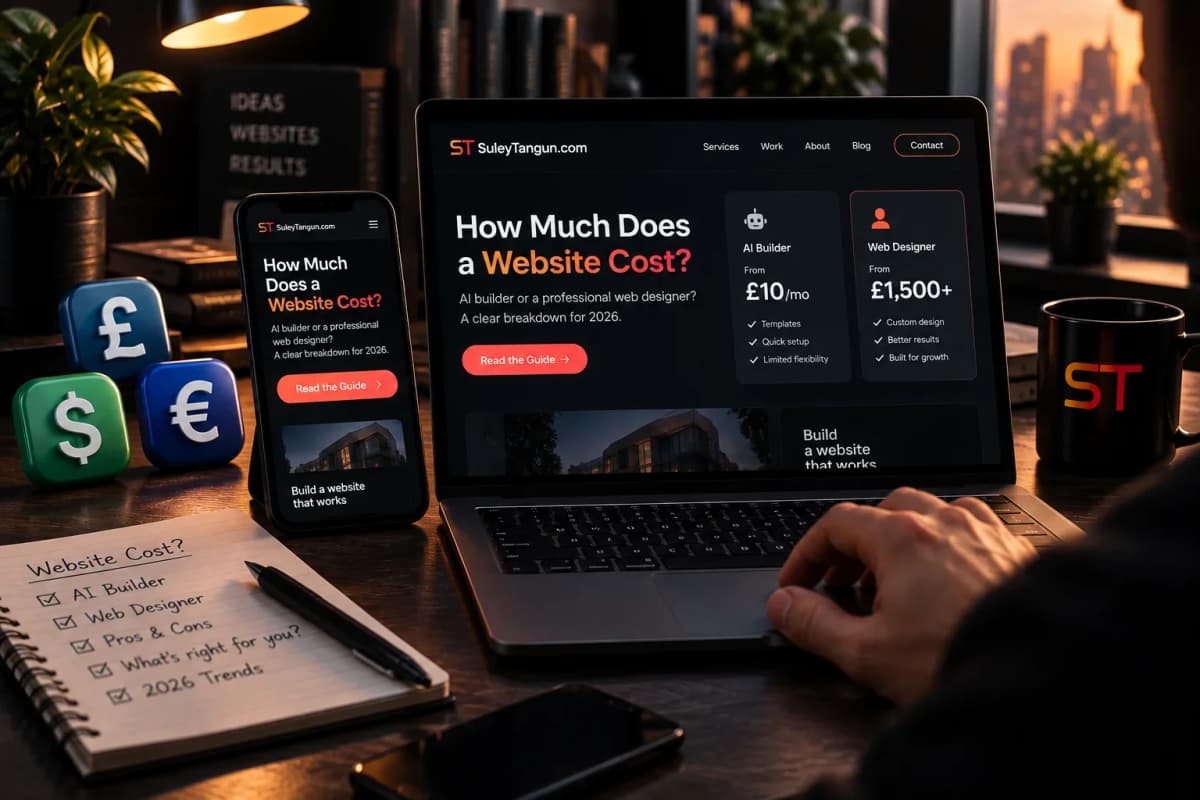
In 2026 a small business has three realistic ways to get a website: build it yourself with an AI website builder, hire a freelancer who builds with AI coding tools, or hire a traditional agency. The first costs little or nothing upfront but costs you time. The second typically sits within the usual freelance range of £500 to £4,000+, depending on the size, complexity and features required. The third usually costs the most for the same scope, and takes the longest.
Path 1: DIY with an AI builder
AI website builders and chat-based tools can produce a decent-looking page in minutes, and many are free to start or charge a modest monthly subscription. For a single-page site, a hobby project, or testing whether an idea has legs, that's a genuinely good option, and I'd tell you so.
The catch is that you're the developer now. When the layout breaks on a phone, when a form stops sending, or when you add a page six months later and the navigation falls apart, you're the one fixing it, usually by prompting the tool again and hoping. Your time has a cost, even if it never shows up on an invoice.
Path 2: A developer who builds with AI
This is how I work. I use AI coding tools like Claude Code to write and refactor code, which removes a lot of the slow, repetitive typing that used to fill a project. What it doesn't remove is the judgement: deciding the structure, checking every page on real devices, setting up the technical SEO, and reviewing what the AI wrote before anything goes live.
That split is why the price can be efficient without being risky. You're paying for the experienced part of the job, not for hours of boilerplate, and you still get a custom site that someone actually understands and can maintain.
Path 3: A traditional agency
Agencies without AI in their process still hand-build most things, then add project management, account handling and office overhead on top. For large, complex projects with lots of stakeholders, that structure can be worth it. For a small business site, you're often paying more and waiting longer for a comparable result.
When DIY stops making sense
The honest line isn't really about budget, it's about what the site needs to do. DIY usually stops being the cheap option once you need:
Enquiries, not just visitors: a site built to turn people into calls, bookings or quote requests.
Search visibility: proper page structure, metadata and speed, so Google can actually rank you.
Room to grow: a site that doesn't break when you add a service page or start a blog.
Working out which path fits
If you're still testing an idea, try a DIY builder first; it's a sensible way to learn what you want. If the site needs to bring in work, it's worth a conversation. Get in touch with what you have in mind and I'll tell you honestly whether you need me, or whether a builder will do the job.
A quick note: this is my own opinion, based on what I've seen work in practice, not formal legal, financial or professional advice. Your situation may differ, so do your own research before making a decision. These views are mine alone and don't reflect any employer or organisation I'm affiliated with.
Sources
Related reading
Frequently asked questions
Are AI website builders good enough for a small business?
For a simple one-page site, a hobby project or testing an idea, yes. Once you need the site to rank in search, bring in enquiries and grow without breaking, the limits start to show, and you become the person responsible for fixing it.
Is a website built with AI tools lower quality?
It depends on who checks the output. AI can write code quickly, but quality comes from an experienced developer deciding the structure, reviewing the code and testing it on real devices. Unreviewed AI output is the risk, not AI itself.
Why can an AI-assisted freelancer cost less than an agency?
Two reasons: AI tools cut the time spent on repetitive code, and a freelancer has no agency overhead such as account managers or office costs. You pay for the design, development and checking, not the layers around it.
Can I start with a DIY builder and move to a custom site later?
Yes, and it's a sensible way to test an idea. Your written content and what you've learned about your customers carry over, but the design and code usually don't move cleanly, so expect a rebuild rather than a straight migration.